

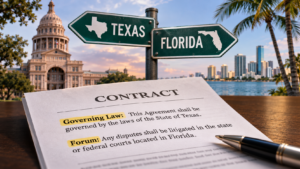
Texas or Florida? Why Governing-Law and Forum Clauses Are Not the Same Thing
A contract says it is “governed by the laws of Florida.” Does that mean a lawsuit must be filed in Florida?
Not necessarily.
This is a common source of confusion in contracts involving parties, property, employees, or businesses located in different states. A governing-law clause, a forum-selection clause, a jurisdiction clause, and a venue provision address related—but distinct—questions. Understanding the differences can become critical when a dispute arises.
Governing Law: What Law Applies?
A governing-law or choice-of-law provision identifies the body of substantive law the parties intend to govern their contractual rights and obligations.
For example: “This Agreement shall be governed by and construed in accordance with the laws of the State of Florida.”
That language addresses what law applies. Standing alone, it does not necessarily dictate where a lawsuit must be filed. A Texas court may, in an appropriate case, apply Florida substantive law, just as a Florida court may sometimes apply another state’s law. The applicable law and the location of the court are separate questions.
Choice-of-law provisions are also subject to applicable conflict-of-laws principles and statutory or public-policy limitations. The wording of the contract is therefore important, but it may not end every choice-of-law inquiry.
Forum Selection: Where Must the Dispute Be Litigated?
A forum-selection clause addresses the jurisdiction or adjudicative forum in which litigation must—or may—occur.
For example: “Any action arising out of this Agreement shall be brought exclusively in the state or federal courts located in Texas.”
That language does something different from a governing-law clause. It identifies a selected forum for litigation.
The precise wording matters. Language merely consenting to jurisdiction in a particular state may not necessarily make that state the exclusive forum. By contrast, words such as “exclusive,” “shall,” or “must,” read in context, can indicate a mandatory forum-selection provision.
Texas courts generally treat mandatory forum-selection clauses as presumptively valid and enforceable, subject to recognized grounds for avoiding enforcement.
Forum and Venue Are Not Necessarily the Same Thing
Texas law also distinguishes a forum-selection clause from a venue-selection clause. A forum clause generally selects the adjudicative jurisdiction, such as a state or nation. Venue concerns the geographic place of trial within the selected judicial system, often a particular county.
That distinction matters because Texas law does not treat every contractual venue provision exactly like a forum-selection clause. Contractual venue selection may depend on statutory authorization and the nature of the transaction. For example, Texas Civil Practice and Remedies Code § 15.020 contains special venue rules for certain “major transactions.”
A contract provision selecting Texas and then naming a particular Texas county can implicate both forum and venue concepts. Drafting the provision as though those terms were interchangeable can create unnecessary preliminary litigation.
Jurisdiction Is Another Question
Jurisdiction concerns a court’s legal authority over the parties and the dispute. Parties can, within legal limits, consent to personal jurisdiction through contractual language.
But consenting to jurisdiction in Texas does not necessarily mean Texas is the only place where litigation can occur.
For example, “The parties consent to the jurisdiction of the courts of Texas” may operate differently from “The parties agree that all disputes shall be brought exclusively in the state or federal courts located in Texas.” The first addresses consent; the second more clearly attempts to designate an exclusive forum.
One Transaction May Contain Several Different Provisions
Consider a hypothetical transaction between a Texas company and a Florida company. One agreement provides that Florida law governs. Another states that disputes must be litigated in Texas. Those provisions are not necessarily inconsistent: the parties may have selected a Texas forum while agreeing that Florida substantive law will govern particular contractual issues.
The analysis becomes more complicated when a transaction includes several related contracts—for example, an asset purchase agreement, license agreement, employment or consulting agreement, promissory note, restrictive covenant, transition agreement, or amendment—and the documents do not use the same governing-law and forum language.
Before the parties can litigate the underlying breach-of-contract claim, they may first have to determine which agreement governs the dispute, whether one agreement supersedes or incorporates another, and how broadly each dispute-resolution provision reaches.
Related Agreements Require Careful Reading
Important questions can include:
• Does one agreement expressly supersede another?
• Is there an integration or merger clause?
• Which provisions survive closing or termination?
• Does a later agreement modify an earlier agreement?
• Does one agreement incorporate another by reference?
• Which contract gives rise to the particular claim?
• Does the clause cover only disputes “arising under” the agreement, or does it use broader language such as disputes “arising out of or relating to” the agreement?
• Is the forum provision mandatory or merely permissive?
• Does the provision select a state, a particular court system, or a county?
Sometimes the preliminary dispute over where the case belongs turns on the scope and wording of the contracts rather than simply on where the parties are physically located.
Forum-Selection Clauses Should Not Be Treated as Boilerplate
Texas courts generally enforce mandatory contractual forum-selection clauses. The Texas Supreme Court has recognized limited grounds for resisting enforcement, including circumstances in which enforcement would be unreasonable or unjust, the clause is invalid because of fraud or overreaching, enforcement would contravene a strong public policy of the forum, or the selected forum would be seriously inconvenient under the governing standard.
That means a few sentences near the end of a contract can determine where future litigation occurs and substantially affect its cost, leverage, discovery, and strategy.
Waiver can also become an issue. A party seeking to enforce a forum-selection clause should ordinarily raise the issue promptly rather than substantially invoking the judicial process and only later attempting to change forums.
Federal Court Can Add Another Layer
When litigation proceeds in federal court, forum-selection and choice-of-law issues can become more complicated. Federal procedural law may affect how a forum-selection clause is enforced, while state choice-of-law principles may affect substantive-law questions.
For that reason, simply identifying the state named in the contract may not answer every question concerning where the dispute should be litigated or what law ultimately applies.
Read These Clauses Before the Dispute, Not After
Businesses often negotiate price, payment, performance obligations, warranties, indemnity, and termination rights carefully while paying relatively little attention to provisions labeled “Miscellaneous,” “General,” or “Governing Law.”
Those provisions deserve attention before the agreement is signed. Parties should understand:
• what law is intended to govern;
• where disputes may or must be filed;
• whether the selected forum is exclusive;
• whether the parties are consenting to personal jurisdiction;
• whether a particular county is being selected and whether that venue provision is enforceable;
• how related agreements interact; and
• whether the practical cost of litigating in the selected forum makes sense for the transaction.
The Practical Lesson
Governing law answers “what law?” Forum selection addresses “which forum?” Jurisdiction asks whether the court has authority over the parties and dispute. Venue concerns the geographic location of the proceeding within the court system.
Those concepts overlap, but they are not interchangeable.
When a transaction crosses state lines—or contains several related agreements—the exact language can materially affect where a dispute is litigated, what law governs, and how expensive the dispute becomes.
Noskin Law Firm, PLLC represents businesses and individuals in selected interstate contract, commercial, licensing, and business disputes.
This article is provided for general informational purposes only and does not constitute legal advice. The enforceability and interpretation of contractual provisions depend upon the specific language, governing law, forum, transaction, and circumstances.
Publication review note: the Texas forum-selection and venue discussion was reviewed against current Texas authorities before preparation of this publication draft.